Occasion
Dog treat cutters: bones, paws and breeds
Bones, paws and breed silhouettes: why stiff dog-biscuit dough needs thicker walls, and which shapes actually make it through in one piece.
Editorial responsibility: Cookie-AI · Wagner, Wunderlich & Lorenz GbR · Updated:
Skip to the ready-made promptsDog treats are the case where the dough dictates the model. A mix of wholemeal flour, oats and pumpkin or liver is much firmer and tougher than shortcrust — it does not part under gentle pressure. A cutter that was fine for biscuits will flex here. In practice: more height, thicker walls, four perimeters, and PETG rather than PLA, because PLA goes brittle under sustained sideways load.
Among the shapes, the bone is the safest bet: compact, symmetrical, no narrow sections, and instantly readable for the purpose. The paw is more popular but trickier — the four toe pads are really separate islands, and a cutter cannot cut separate islands. Ask for a paw whose toes touch the main pad; what is left is a closed silhouette that still reads as a paw.
Breed silhouettes work if you think about the pose. A sitting dog in profile with a folded tail and drop ears holds up; a standing sighthound with long thin legs does not. One more thing people skip on dog biscuits: printed parts are not food-safe on their own, and that applies to dogs exactly as it does to people. The food-safety guide below spells out what that means in practice.
Inspect an actual model
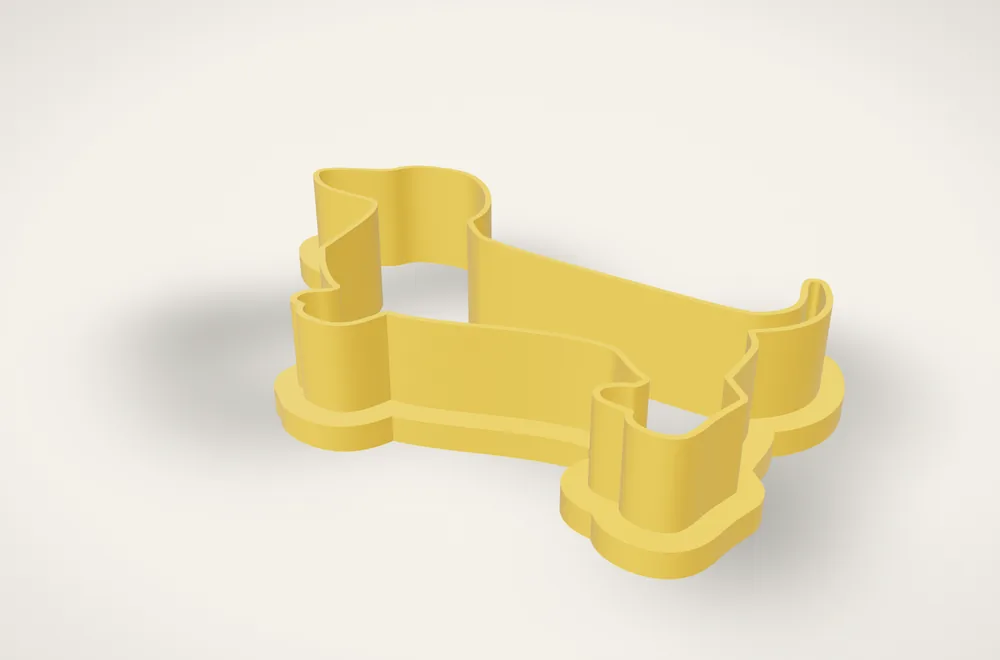
Prompt: a dachshund in profile
The dachshund expresses a breed through proportions: long body, short legs and a distinct head area. It does not test a pet photo with a collar, coat pattern or several animals. Choose one animal, one view and one connected silhouette. If reducing size leaves the tail attached by a thin link, revise the design; an attractive rendering cannot strengthen that connection.
- File dimensions (X × Y × Z):
- 80 × 49.31 × 15 mm
- Triangles:
- 27,574
Ready-made prompts
Each one opens the generator with the wording in place. Change anything you like before you spend a credit.
- Cookie cutterStarts straight awayDog bone with two rounded ends and a straight middle, closed silhouette, about 90 mm wideCompact and symmetrical — the shape that gets through firm treat dough.Open in the generator
- Cookie cutterStarts straight awayDog paw with a large pad and four toes touching the pad, closed outline, about 80 mm wideTouching toes turn four islands into one silhouette a cutter can actually cut.Open in the generator
- Cookie cutterStarts straight awaySitting labrador in profile with a folded tail and drop ears, compact silhouette, about 95 mm tallA sitting pose rather than standing: no thin legs, no protruding tail.Open in the generator
- Cookie cutterStarts straight awayDachshund in profile with a long body, short thick legs and drop ears, about 110 mm wideThe long body is fine; the short, sturdy legs are what makes it survive.Open in the generator
- Cookie cutterStarts straight awaySitting cat seen from the front with a round body, pointed ears and front paws together, about 85 mm tallFor cat treats too: compact, closed, and no whiskers.Open in the generator
- Cookie cutterStarts straight awayFish in profile with a thick tail fin and a closed contour, about 80 mm wideA solid tail fin instead of fanned rays that catch in the dough.Open in the generator
- Cookie stampSet the object switch firstBUDDYYour pet's name — swap in the real one. The paw itself is already a cutter further up the list.Open in the generator
Worth reading next
- Food safety for printed cutters and stampsMaterials, printing, documentation and commercial use: what to check before food contact.
- Print without drama: basics for cutters and stampsPLA and PETG, 0.2 mm layers, walls, orientation, brim. A slicer checklist with Cura, PrusaSlicer and Bambu Studio as examples.