Occasion
Easter cookie cutters: bunny, egg and chick
Why long bunny ears snap off, which Easter shapes stay compact enough to cut, and seven prompts for eggs, chicks, lambs and carrots.
Editorial responsibility: Cookie-AI · Wagner, Wunderlich & Lorenz GbR · Updated:
Skip to the ready-made promptsEaster is structurally easier than Christmas. The egg is the most forgiving silhouette there is: closed, convex, no narrow section anywhere. Chicks, lambs and tulips work for the same reason. The one genuine problem is the rabbit, and specifically its ears. An upright bunny with two long, slim ears has its thinnest cross-section exactly where your hand puts the most pressure.
The fix is not more wall thickness, it is a different pose. A sitting rabbit in profile, ears folded back along the head, keeps the recognisable shape and loses the freestanding sections. If the ears must stand up, say explicitly that they are broad and joined to the head at the base. Everything else is ordinary practice: cold dough, straight down, and knock the cutter out every few biscuits because scraps collect in the gap between the ears.
Easter biscuits usually get decorated, and that changes what matters about the edge. Royal icing needs a clean, straight biscuit edge to flood against, otherwise it runs off. A slightly tapered blade and a cleanly printed bottom perimeter buy you more here than any detail in the shape. Three to four perimeters, 0.2 mm layers, and if the first test biscuit has ragged edges, the dough was too warm — that is almost never the model's fault.
Inspect an actual model
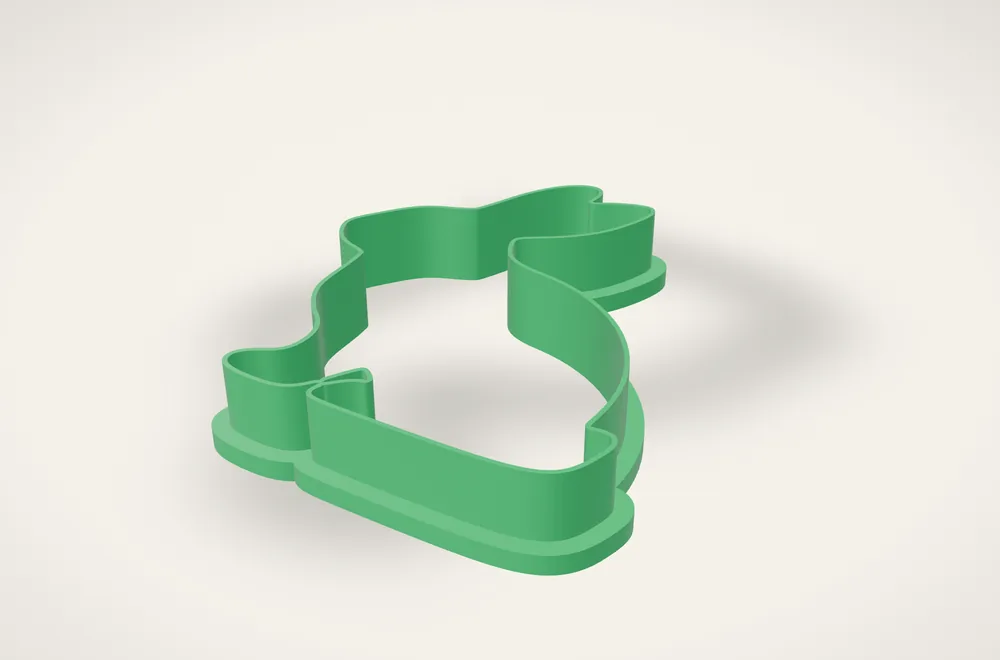
Prompt: a sitting rabbit
The Easter rabbit has an 80 × 97.77 mm footprint, making it taller than a circle of the same width. Check the entire rectangle for small packaging. The ears belong to the outline; they do not add a face or fur. An egg with an interior pattern is a different task requiring a separate stamp result.
- File dimensions (X × Y × Z):
- 80 × 97.77 × 15 mm
- Triangles:
- 26,150
Ready-made prompts
Each one opens the generator with the wording in place. Change anything you like before you spend a credit.
- Cookie cutterStarts straight awaySitting rabbit in profile with ears folded back and a round body, closed outline, about 90 mm tallFolded ears mean no freestanding sections, the usual break point on Easter cutters.Open in the generator
- Cookie cutterStarts straight awayEaster egg with a smooth, even outline, about 75 mm tallThe simplest shape here and the best test print before you attempt anything harder.Open in the generator
- Cookie cutterStarts straight awayEaster egg with a scalloped edge, six shallow waves, about 75 mm tallShallow waves instead of deep notches: the dough releases without tearing.Open in the generator
- Cookie cutterStarts straight awayChick with a round body and a short triangular beak, no legs, about 70 mm tallLeaving the legs off is not laziness — thin legs break on the first press.Open in the generator
- Cookie cutterStarts straight awayCarrot with three thick leaves at the top, closed contour, about 90 mm tallThree sturdy leaves rather than feathery greens, which become hairline bridges.Open in the generator
- Cookie cutterStarts straight awayLamb as a compact silhouette in profile, round body, short thick legs, about 85 mm wideShort thick legs hold; long slim ones are the second most common break after ears.Open in the generator
- Cookie stampSet the object switch firstHappy EasterPressed onto an egg-shaped biscuit after the egg cutter has done its job. One line, bold capitals, oval plate around 80 mm.Open in the generator
Worth reading next
- Prompts the printer can actually useNouns over mood words, size cues, clear silhouettes. Six good and bad pairs — and how to iterate with credits instead of guessing.
- Cutter or stamp: what you actually needThe choice drives shape, wall thickness and how you press. When to cut, when to stamp — and how Cookie-AI’s object switch maps to that decision.