Occasion
Ideas by occasion: shapes that hold up
Twelve occasions on one page. Each one says which designs survive the cutting edge, which break and why, plus prompts that open the generator already filled in.
Editorial responsibility: Cookie-AI · Wagner, Wunderlich & Lorenz GbR · Updated:
Christmas cookie cutters you can print at home
Trees, stars and gingerbread people: which Christmas shapes survive a cutting edge, what tears in the dough, and prompts you can run right now.
Christmas brings the widest range of shapes and the highest failure rate. What works reliably is a compact silhouette with one continuous outline: tree, bell, star, gingerbread figure, snowman, candle. What fails again and again are the delicate favourites — a real ice-crystal snowflake, a reindeer with branching antlers, lettering cut rather than pressed. A snowflake is rescuable if you ask for six thick arms around a solid centre instead of something described as intricate.
In use, dough temperature decides more than the shape does. Warm shortcrust sticks to the inside wall, and a narrow treetop lifts out with it. Chill the dough for half an hour, dip the cutter in flour between presses, and push straight down rather than rocking it. Tight interior angles — the valleys between star points, a snowman's neck — are exactly where dough grips, so ask for rounded transitions instead of sharp notches.
For printing, the classic trap is the set: twelve motifs at once, each 40 mm across so they all fit one tray. At that size every shape loses its detail and the walls drop below what the slicer can fill cleanly. Stay between 70 and 100 mm wide, three to four perimeters, PLA or PETG at a 0.2 mm layer height. You can always scale down later in the slicer — but then you do it deliberately, watching the wall.
Inspect an actual model
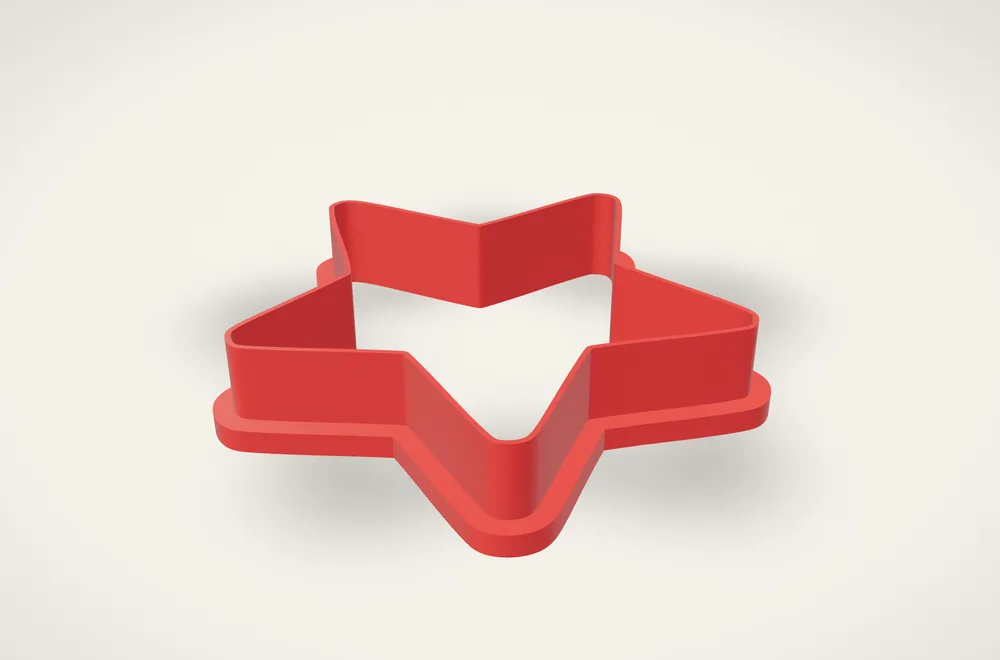
Prompt: a five-pointed star
The star is a concrete starting point for Christmas designs: five large tips without interior detail. A snowflake instead needs thin branches, which this star does not test. Start with broad branches and inspect each one in the layer preview. Plan a hanging hole separately for an ornament; this STL does not include one.
- File dimensions (X × Y × Z):
- 80 × 75.66 × 15 mm
- Triangles:
- 19,544
Ready-made prompts
- Cookie cutterChristmas tree as a closed silhouette with three wide branch tiers and a thick trunk, about 90 mm tall, no interior detailThe wide trunk carries the pressure; without it the tip snaps while you cut.
- Cookie cutterFive-pointed star with slightly rounded tips and thick points, about 80 mm acrossRounded tips release the dough; sharp ones tear it as you lift.
- Cookie cutterGingerbread figure with rounded arms and legs, closed outline, about 100 mm tallEyes and buttons left out on purpose — those belong on a stamp or in the icing.
- Cookie cutterSnowflake with six thick arms and a solid centre, no hairline bridges, about 85 mm acrossSix sturdy arms print and cut cleanly; true crystal branching does neither.
- Cookie cutterChristmas bell with a smooth rim, wide mouth and the clapper attached to the body, about 75 mm tallAttaching the clapper avoids a thin freestanding part that breaks first.
- Cookie cutterCandle with a thick flame and a straight body, closed contour, about 90 mm tallA broad flame stays with the biscuit; a thin tongue of flame shears off.
- Cookie stampSet the object switch firstMerry ChristmasLettering only works as a stamp — a cutter reproduces the outline and nothing inside it. Two lines, bold capitals, round plate around 70 mm.
Worth reading next: Cutter or stamp: what you actually need · Print without drama: basics for cutters and stamps
Easter cookie cutters: bunny, egg and chick
Why long bunny ears snap off, which Easter shapes stay compact enough to cut, and seven prompts for eggs, chicks, lambs and carrots.
Easter is structurally easier than Christmas. The egg is the most forgiving silhouette there is: closed, convex, no narrow section anywhere. Chicks, lambs and tulips work for the same reason. The one genuine problem is the rabbit, and specifically its ears. An upright bunny with two long, slim ears has its thinnest cross-section exactly where your hand puts the most pressure.
The fix is not more wall thickness, it is a different pose. A sitting rabbit in profile, ears folded back along the head, keeps the recognisable shape and loses the freestanding sections. If the ears must stand up, say explicitly that they are broad and joined to the head at the base. Everything else is ordinary practice: cold dough, straight down, and knock the cutter out every few biscuits because scraps collect in the gap between the ears.
Easter biscuits usually get decorated, and that changes what matters about the edge. Royal icing needs a clean, straight biscuit edge to flood against, otherwise it runs off. A slightly tapered blade and a cleanly printed bottom perimeter buy you more here than any detail in the shape. Three to four perimeters, 0.2 mm layers, and if the first test biscuit has ragged edges, the dough was too warm — that is almost never the model's fault.
Inspect an actual model
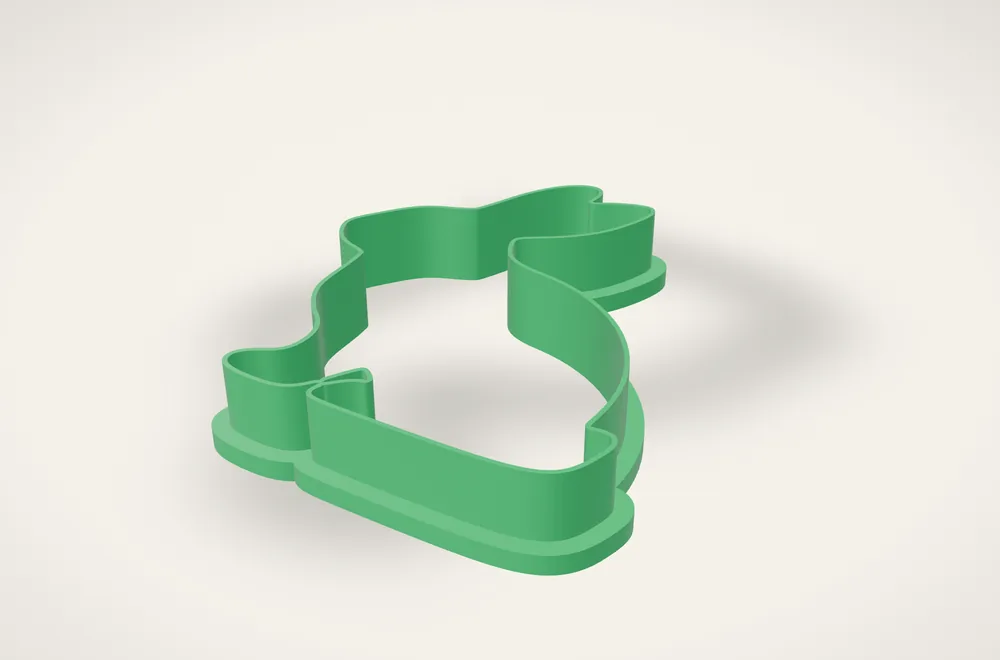
Prompt: a sitting rabbit
The Easter rabbit has an 80 × 97.77 mm footprint, making it taller than a circle of the same width. Check the entire rectangle for small packaging. The ears belong to the outline; they do not add a face or fur. An egg with an interior pattern is a different task requiring a separate stamp result.
- File dimensions (X × Y × Z):
- 80 × 97.77 × 15 mm
- Triangles:
- 26,150
Ready-made prompts
- Cookie cutterSitting rabbit in profile with ears folded back and a round body, closed outline, about 90 mm tallFolded ears mean no freestanding sections, the usual break point on Easter cutters.
- Cookie cutterEaster egg with a smooth, even outline, about 75 mm tallThe simplest shape here and the best test print before you attempt anything harder.
- Cookie cutterEaster egg with a scalloped edge, six shallow waves, about 75 mm tallShallow waves instead of deep notches: the dough releases without tearing.
- Cookie cutterChick with a round body and a short triangular beak, no legs, about 70 mm tallLeaving the legs off is not laziness — thin legs break on the first press.
- Cookie cutterCarrot with three thick leaves at the top, closed contour, about 90 mm tallThree sturdy leaves rather than feathery greens, which become hairline bridges.
- Cookie cutterLamb as a compact silhouette in profile, round body, short thick legs, about 85 mm wideShort thick legs hold; long slim ones are the second most common break after ears.
- Cookie stampSet the object switch firstHappy EasterPressed onto an egg-shaped biscuit after the egg cutter has done its job. One line, bold capitals, oval plate around 80 mm.
Worth reading next: Prompts the printer can actually use · Cutter or stamp: what you actually need
Halloween cutters: pumpkin, ghost and bat
Pumpkins, ghosts, bats and black cats: which silhouettes hold up, why spider legs snap, and how the jack-o-lantern face actually gets there.
Halloween motifs live on faces, and that is precisely where home-made cutters fall down. A pumpkin with triangular eyes and a jagged mouth cannot be a cutter: a cutter reproduces the outline and leaves everything inside as solid dough. The face belongs on a cookie stamp pressed into the pumpkin shape after cutting. That split — cut the contour, emboss the face — is the difference between a set that works and one that disappoints.
The silhouettes themselves are mostly easy. Ghost, pumpkin, tombstone and a sitting cat are all compact with one continuous outline. The bat works if the wing scallops stay shallow; deep, pointed notches between the wing fingers grip the dough and tear it as you lift. A spider with eight thin legs is close to unsalvageable. If you must have one, keep the legs short, thick and touching the body.
Halloween dough is often dark chocolate shortcrust, which is softer and stickier than the plain kind. Chill it longer, flour the edge more often, and lift the biscuits to the tray inside the cutter rather than moving them afterwards. For printing, 0.2 mm layers and three perimeters are enough — and if you print in black filament, study the preview first, because thin sections are hard to spot on dark material.
Inspect an actual model
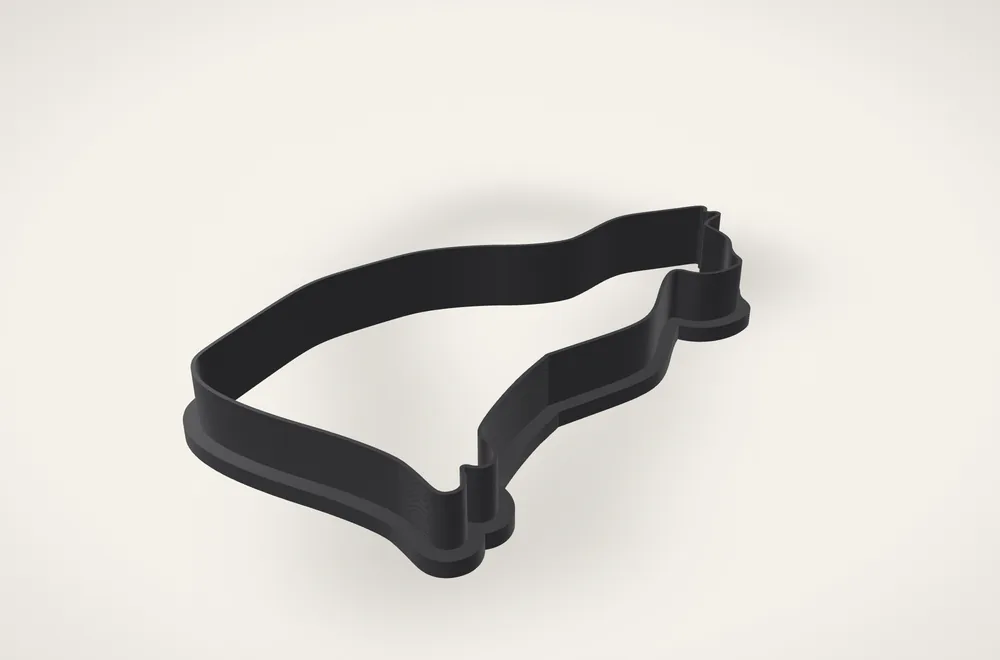
Prompt: a sitting cat
A cat outline can serve as a Halloween motif without a face or text. At 80 mm wide, this cat is 120.69 mm tall, so it does not automatically match an 80 mm pumpkin in a small set. Decide whether height or width should match. A pumpkin face requires relief or extra geometry; an ordinary outline does not cut out eyes.
- File dimensions (X × Y × Z):
- 80 × 120.69 × 15 mm
- Triangles:
- 20,220
Ready-made prompts
- Cookie cutterPumpkin with a ribbed outline and a short thick stem, closed silhouette, about 90 mm wideOutline only — the face arrives with the stamp further down this list.
- Cookie stampSet the object switch firstBOOPressed into the tombstone or a plain round biscuit. Short enough to stay readable at small sizes.
- Cookie cutterGhost with a round head and a wavy lower edge, three shallow waves, about 85 mm tallShallow waves release cleanly; deep points hold onto the dough.
- Cookie cutterBat with broad wings and shallow scallops along the wing edges, closed contour, about 100 mm wideBroad wings spread the pressure; deep pointed notches tear the dough.
- Cookie cutterSitting cat in profile with an arched back, pointed ears and the tail against the body, about 85 mm tallKeeping the tail against the body avoids a thin freestanding curve.
- Cookie cutterTombstone with a rounded top and a straight base, closed silhouette, about 80 mm tallOne of the sturdiest shapes here and a sensible first test print for the set.
- Cookie stampSet the object switch firstTrick or TreatFits the tombstone or a plain round biscuit; as a cutter, lettering is impossible. Two lines, bold capitals, rectangular plate around 70 mm.
Worth reading next: Cutter or stamp: what you actually need · Prompts the printer can actually use
Kids' birthday cutters: numbers, dinos, rockets
Sturdy shapes for themed biscuits, why the hole in an 8 never gets cut, and prompts that stand up to small hands pressing sideways.
The birthday number is the most searched-for kids' party cutter and the one that surprises people most: a cutter only reproduces the outline. On a 4, 6, 8, 9 or 0 the enclosed areas stay filled with dough — the digit reads as a silhouette, the holes do not appear. That is how cutting works, not a defect. If you want the holes, punch them afterwards with a small round cutter, or use a stamp for the detail instead.
Once children are doing the cutting, the requirements change. Small hands press unevenly, at an angle, often on one side. That rules out thin protrusions and argues for larger shapes: 80 to 100 mm is much easier to hold than 50 mm. A wider rim at the top to push against helps more than any amount of detail. Print two of the popular shape while you are at it — with six children, someone is always waiting.
On the tray, themed biscuits usually get bright icing, and icing wants area. Compact shapes with a calm outline — rocket, crown, dinosaur, number — take icing better than jagged ones. Print in PLA with three or four perimeters; PETG is tougher if the cutters really have to survive a room full of children. Bake one test biscuit first, because a size that looked right on screen often looks different on the tray.
Ready-made prompts
- Cookie cutterNumber 5 as a closed silhouette with thick, evenly weighted strokes, about 90 mm tallThe 5 has no enclosed area, which makes it the least troublesome birthday digit.
- Cookie cutterRocket with a pointed nose and three thick fins, closed contour, about 100 mm tallThick fins rather than slim ones survive being pressed at an angle.
- Cookie cutterDinosaur in profile with a round body, short thick legs and low back plates, about 110 mm wideLow back plates instead of sharp spikes, which trap dough and tear it.
- Cookie cutterCrown with three broad rounded points and a straight band, about 85 mm wideThree broad points release the dough; five narrow ones tear it between the tips.
- Cookie cutterUnicorn head in profile with a thick horn and the mane against the neck, closed outline, about 95 mm tallThe horn is deliberately short and broad at the base so it does not snap off.
- Cookie cutterCloud with three large bumps and a flat bottom, about 90 mm wideThe simplest shape on the list and a good first go for the youngest guests.
- Cookie stampSet the object switch firstMAXPlace-name biscuits for the table — a stamp pressed into a plain round biscuit. Swap in the name of whoever is being celebrated.
Worth reading next: Prompts the printer can actually use · Print without drama: basics for cutters and stamps
Wedding cookie cutters and monogram stamps
Hearts, doves, cakes and initials for favours: which shape survives two hundred presses, and how to keep a monogram readable in dough.
A wedding is the highest-volume occasion there is. Eighty guests turns into two hundred biscuits, and that is the real requirement: the cutter does not have to be beautiful, it has to pass through cold dough two hundred times without deforming. So PETG rather than PLA, four perimeters rather than three, and a shape with no narrow sections. A plain heart with a smooth edge is the most reliable choice for exactly that unglamorous reason.
Initials are the second request and the most common misstep. A monogram in flowing script, made as a cutter, has thin joins between the letters and open loops that close up in the dough. The same monogram as a cookie stamp works perfectly: cut the biscuit round or oval, then press the letters in. Wedding rings fall into the same category — a ring is a circle with a hole, and a cutter does not cut the hole.
When the biscuits get boxed and handed out, the edge matters more than usual. A clean, straight cut face takes icing evenly and does not chip in the bag. Chill the dough properly, cut briskly, and lift the blanks to the tray inside the cutter. And do a trial run of ten biscuits a fortnight beforehand — not to test the model, but because people consistently underestimate the time and the quantity of dough two hundred takes.
Inspect an actual model
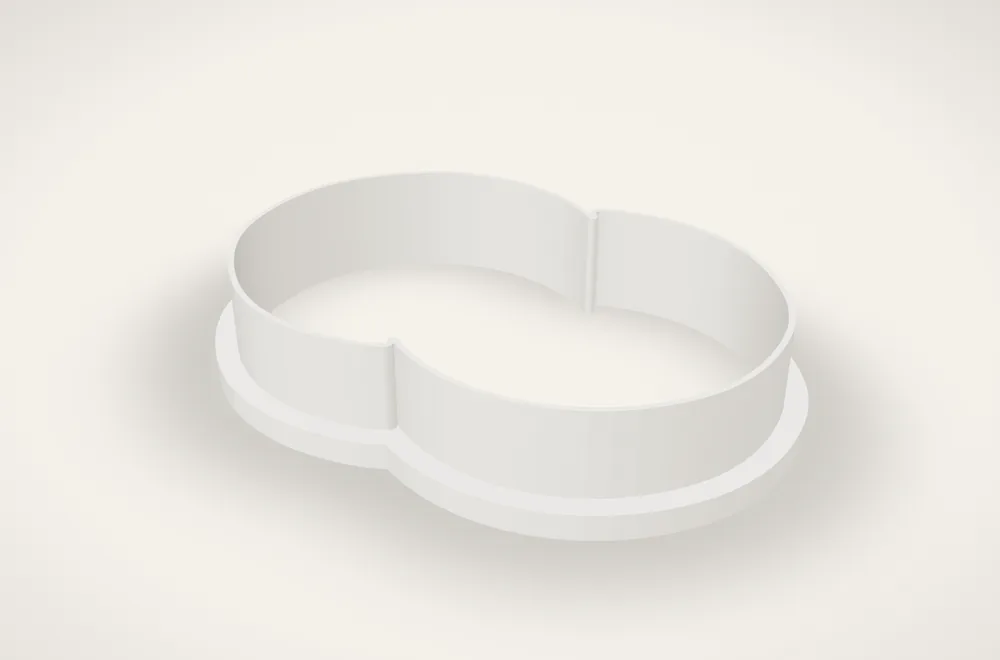
Prompt: two interlocking rings
The wedding rings show why a motif name does not promise every detail: the result has one combined outer frame. It does not cut out two ring holes. Use this silhouette as a base for a decorated surface; a visible crossing requires separate relief. Check the two tasks separately before planning a large batch with one tool.
- File dimensions (X × Y × Z):
- 80 × 55.51 × 15 mm
- Triangles:
- 12,850
Ready-made prompts
- Cookie cutterClassic heart with a smooth, even outline, about 80 mm wideNo narrow sections and no points: the shape that survives two hundred presses.
- Cookie cutterTwo interlocking hearts drawn as one single closed silhouette, about 100 mm wideAsked for as one continuous outline, otherwise you get two fragile pieces.
- Cookie cutterDove in profile with a folded wing and a short tail, closed contour, about 90 mm wideFolded wing instead of spread ones — feather tips would print far too thin.
- Cookie cutterThree-tier wedding cake as a closed silhouette with straight edges, about 85 mm tallThe tiers are steps in the outline, not interior lines; a cutter cannot cut interior lines.
- Cookie cutterOval biscuit with a smooth edge as a blank for stamping, about 85 mm wideThe blank for the monogram below: cut first, then emboss.
- Cookie stampSet the object switch firstA & BAs a stamp the letters stay readable; as a cutter the joins would be too thin. Swap in your own initials. Round plate around 60 mm.
- Cookie cutterTwo interlocking rings as one closed outline, about 80 mm wideThe cut follows the outer boundary of both rings together; the dough inside them stays.
Worth reading next: Cutter or stamp: what you actually need · Finishing and care for cutters and stamps
Baby shower cutters: onesie, footprint, pram
Onesies, footprints, dummies and clouds: which shapes stay compact enough to cut cleanly, and how the baby's name gets onto the biscuit.
Baby shower motifs tempt you into small detail: tiny toes, bows, a ruffle on the sleeve. None of that survives as a cutting edge. What holds up are the compact classics — onesie, cloud, moon, bottle, pram. The onesie is the best shape in the whole category: broad area, soft curves, not one narrow section, and instantly recognisable.
Two motifs need translating. A footprint has five toes drawn as separate circles, and a cutter cannot cut separate areas, so the toes have to touch the foot. A dummy is a ring plus a teat; the ring is a hole, and holes come from embossing, not from cutting. Either describe it as a closed silhouette with a solid handle, or make it a stamp in the first place.
Baby shower biscuits are nearly always iced, often in pastels with a name on top. That wants a clean, straight cut face for the icing to flood against: cold dough, a brisk press, and lift the blank to the tray inside the cutter. The name belongs on a cookie stamp, never in the blade. For printing, PLA at 0.2 mm with three perimeters is plenty — none of these shapes is demanding.
Ready-made prompts
- Cookie cutterBaby onesie with short sleeves and soft rounded corners, closed silhouette, about 90 mm tallBroad area, no narrow sections: the most reliable shape in this set.
- Cookie cutterBaby footprint with five round toes touching the foot, closed outline, about 70 mm tallTouching toes make one silhouette; separate circles could not be cut at all.
- Cookie cutterPram in profile with two solid round wheels and a closed hood, about 90 mm wideSolid wheels rather than spokes — spokes are interior detail and vanish when cutting.
- Cookie cutterCloud with three large bumps and a flat bottom, about 85 mm wideThe simplest shape here, and a generous surface for icing and lettering.
- Cookie cutterBaby bottle with a wide body and a thick teat, closed contour, about 85 mm tallThe teat is deliberately thick where it joins, so it does not tear off as you cut.
- Cookie cutterThick crescent moon of even width, about 80 mm tallEven width instead of tapering to points, which would break first.
- Cookie stampSet the object switch firstWelcomePressed into a cloud or onesie biscuit once it has been cut. One line, bold capitals, oval plate around 75 mm.
Worth reading next: Cutter or stamp: what you actually need · Finishing and care for cutters and stamps
Mother's Day and Father's Day cutters and stamps
Flowers, hearts, mugs and ties: which shapes hold as a cutting edge, why petals tear the dough, and how a greeting gets into the biscuit.
Flowers are the Mother's Day motif and the most common failure. The culprit is the notch between petals: the deeper and sharper it is, the harder the dough grips inside it and tears as you lift. Five broad, round petals with shallow notches read exactly as a flower and release cleanly. A tulip with three petals and a thick stem is the sturdiest flower shape there is.
For Father's Day the usual motifs are a mug, a tie, tools and a moustache. The mug carries the same trap as a wedding ring: in real life the handle is a loop with a hole through it, and a cutter does not cut holes. Describe the handle as a solid area attached to the body and the silhouette stays both readable and strong. A moustache traditionally tapers to fine points — which is exactly where it breaks. Thick, rounded ends solve it without losing the shape.
Greetings belong on a cookie stamp in both cases. Wording cut as a silhouette is a chain of thin joins and breaks on the first press; the same words embossed into a round or rectangular biscuit are legible immediately. If you want both, cut the shape first and press the text in while the dough is still soft.
Ready-made prompts
- Cookie cutterTulip with three broad petals, a thick stem and two flat leaves, closed silhouette, about 95 mm tallThe sturdiest flower shape: no deep notch and no thin stem.
- Cookie cutterFlower with five broad round petals and shallow notches between them, about 85 mm wideShallow notches release the dough; deep sharp ones tear it.
- Cookie cutterClassic heart with a smooth outline, about 80 mm wideWorks for either day and is the simplest test print on the list.
- Cookie cutterCoffee mug in profile with the handle as a solid area against the body, closed contour, about 85 mm wideA solid handle rather than a loop — the hole would never appear when cutting.
- Cookie cutterNecktie with a wide knot and a straight blade, closed silhouette, about 90 mm tallThe knot gives you area to press on without thinning the point below.
- Cookie cutterMoustache with thick rounded ends and a curved top edge, about 100 mm wideRounded ends instead of fine tapers, which is where this shape otherwise snaps.
- Cookie stampSet the object switch firstBest MumGreetings only work as a stamp; as a cutter the letters would not be joined at all. Two lines, bold capitals, round plate around 65 mm.
- Cookie stampSet the object switch firstThanks DadPressed into a rectangular biscuit, whose straight edge frames the text neatly. Two lines, bold capitals, rectangular plate around 70 mm.
Worth reading next: Prompts the printer can actually use · Cutter or stamp: what you actually need
Back to school cookie cutters and name stamps
Pencils, apples, buses and letters for the first week of term: which shapes survive a lunchbox, and stamps that put a name on every biscuit.
Back-to-school biscuits mostly end up in a lunchbox, and that is the constraint worth designing around. A shape with a thin protrusion survives the tray and then snaps in the bag. A pencil with a thick point holds; the same pencil with a finely tapered lead does not. Apples, buses, backpacks and single letters are all compact enough to travel.
Letters need one decision up front. A cutter reproduces the outline only, so the enclosed areas in A, B, D, O and 0 stay filled with dough. For a single large initial that is perfectly fine. For a whole name it is not: the letters would need to touch, and the joins become the thinnest sections in the model. Names and class numbers go on a cookie stamp instead, pressed into a plain round biscuit.
For printing, none of these shapes is demanding: PLA at 0.2 mm layers with three perimeters covers all of them. Scale to 80 or 90 mm rather than 60 if children are doing the cutting — a bigger cutter is easier to hold straight, and a straight press is what gives a clean edge. Bake one test biscuit before committing to a batch of thirty.
Ready-made prompts
- Cookie cutterSchool bus in profile with two solid round wheels and a straight roof, closed silhouette, about 100 mm wideSolid wheels rather than spokes; spokes are interior detail and never get cut.
- Cookie cutterPencil with a thick point and a straight shaft, closed contour, about 100 mm tallA thick point survives both the cutting and the trip to school.
- Cookie cutterApple with a short thick stem and one broad leaf, closed outline, about 80 mm tallOne broad leaf instead of two narrow ones: fewer edges for the dough to tear against.
- Cookie cutterBackpack as a compact silhouette with rounded corners and straps against the body, about 85 mm wideStraps kept against the body stay part of the area instead of thin freestanding arcs.
- Cookie cutterCapital letter A as a closed silhouette, bold sans-serif, even stroke weight, about 75 mm tallA single initial: the enclosed triangle stays filled, which does not matter here.
- Cookie cutterRuler as a rectangle with rounded corners and a straight edge, about 110 mm longThe markings belong on a stamp; as a cutter this is simply a clean rectangle.
- Cookie stampSet the object switch firstFirst DayPressed into a plain round biscuit — as a cutter the wording would fall apart. Two lines, bold capitals, round plate around 65 mm.
Worth reading next: Prompts the printer can actually use · Print without drama: basics for cutters and stamps
Dog treat cutters: bones, paws and breeds
Bones, paws and breed silhouettes: why stiff dog-biscuit dough needs thicker walls, and which shapes actually make it through in one piece.
Dog treats are the case where the dough dictates the model. A mix of wholemeal flour, oats and pumpkin or liver is much firmer and tougher than shortcrust — it does not part under gentle pressure. A cutter that was fine for biscuits will flex here. In practice: more height, thicker walls, four perimeters, and PETG rather than PLA, because PLA goes brittle under sustained sideways load.
Among the shapes, the bone is the safest bet: compact, symmetrical, no narrow sections, and instantly readable for the purpose. The paw is more popular but trickier — the four toe pads are really separate islands, and a cutter cannot cut separate islands. Ask for a paw whose toes touch the main pad; what is left is a closed silhouette that still reads as a paw.
Breed silhouettes work if you think about the pose. A sitting dog in profile with a folded tail and drop ears holds up; a standing sighthound with long thin legs does not. One more thing people skip on dog biscuits: printed parts are not food-safe on their own, and that applies to dogs exactly as it does to people. The food-safety guide below spells out what that means in practice.
Inspect an actual model
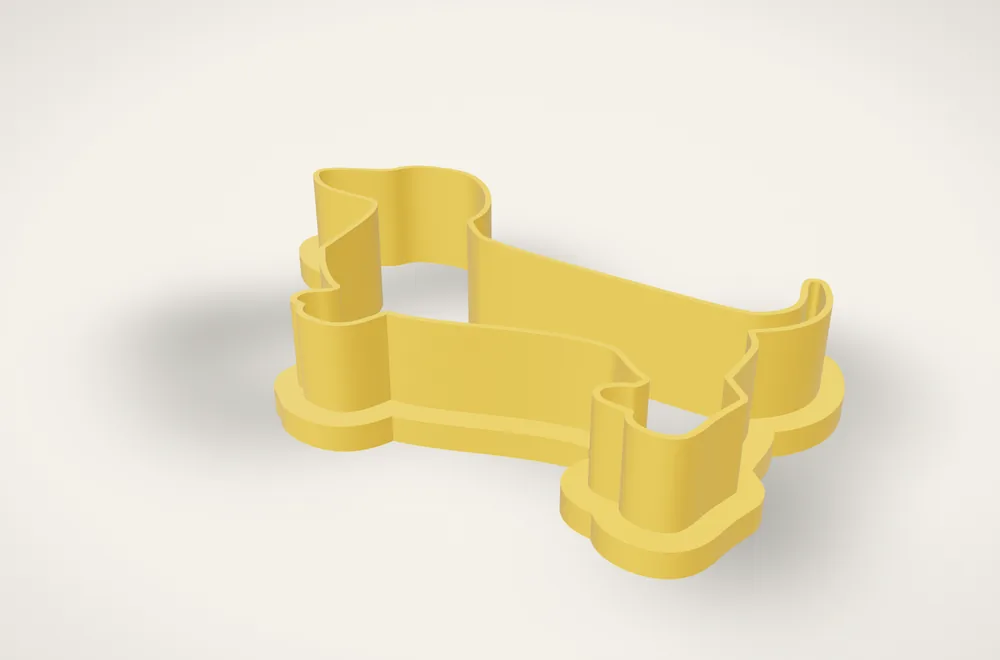
Prompt: a dachshund in profile
The dachshund expresses a breed through proportions: long body, short legs and a distinct head area. It does not test a pet photo with a collar, coat pattern or several animals. Choose one animal, one view and one connected silhouette. If reducing size leaves the tail attached by a thin link, revise the design; an attractive rendering cannot strengthen that connection.
- File dimensions (X × Y × Z):
- 80 × 49.31 × 15 mm
- Triangles:
- 27,574
Ready-made prompts
- Cookie cutterDog bone with two rounded ends and a straight middle, closed silhouette, about 90 mm wideCompact and symmetrical — the shape that gets through firm treat dough.
- Cookie cutterDog paw with a large pad and four toes touching the pad, closed outline, about 80 mm wideTouching toes turn four islands into one silhouette a cutter can actually cut.
- Cookie cutterSitting labrador in profile with a folded tail and drop ears, compact silhouette, about 95 mm tallA sitting pose rather than standing: no thin legs, no protruding tail.
- Cookie cutterDachshund in profile with a long body, short thick legs and drop ears, about 110 mm wideThe long body is fine; the short, sturdy legs are what makes it survive.
- Cookie cutterSitting cat seen from the front with a round body, pointed ears and front paws together, about 85 mm tallFor cat treats too: compact, closed, and no whiskers.
- Cookie cutterFish in profile with a thick tail fin and a closed contour, about 80 mm wideA solid tail fin instead of fanned rays that catch in the dough.
- Cookie stampSet the object switch firstBUDDYYour pet's name — swap in the real one. The paw itself is already a cutter further up the list.
Worth reading next: Food safety for printed cutters and stamps · Print without drama: basics for cutters and stamps
Name and letter cookie cutters that stay readable
Letters as cutters, names as stamps: why A, B and O lose their holes, which typefaces survive the dough, and how to keep a monogram legible.
Letters are the stress test for the difference between cutting and embossing. A cutter separates along one closed line. But A, B, D, O, P, Q and R — and 0, 4, 6, 8 and 9 — carry a second, inner line: the counter. A cutter does not cut that, so the area stays dough. The result is a recognisable but filled O. If you need the inner shape, use a stamp, or punch it afterwards with a small round cutter.
For the typeface, stroke weight decides everything. Script and serif faces have thin passages by design — hairlines, serif feet, the joins — and those are precisely what takes the load while you cut. A bold grotesque with even stroke weight is the only class that holds up reliably as a cutter. Say so in the prompt: asking for bold sans-serif capitals with even stroke weight prevents more failed prints than any amount of repair afterwards.
A whole name as a single cutter rarely works. The letters have to touch or the part falls into pieces, and those contact points then become the thinnest sections in the model. From about five letters onward, a cookie stamp is the better answer: cut a round or rectangular biscuit and press the name in. Single letters, on the other hand, make good cutters — 60 to 80 mm tall gives even the narrowest stroke enough material.
Ready-made prompts
- Cookie cutterCapital letter M as a closed silhouette, bold sans-serif, even stroke weight, about 75 mm tallThe M has no counter, which makes it one of the least troublesome letters.
- Cookie cutterCapital letter A as a closed silhouette, bold sans-serif, even stroke weight, about 75 mm tallThe triangle inside the A stays filled — intentionally, since a cutter only cuts the outside.
- Cookie cutterNumber 1 as a closed silhouette with a thick stroke and a wide foot, about 80 mm tallThe wide foot stops a narrow digit from tipping over as you press.
- Cookie cutterRectangular name plaque with rounded corners as a blank for stamping, about 90 mm wideThe blank for the name stamps below: cut first, then emboss.
- Cookie stampSet the object switch firstEMMAFull names belong on a stamp — as a cutter the joins between letters would be too thin. Swap in your own name. One line, plate around 90 mm.
- Cookie stampSet the object switch firstABTwo letters on a small face need heavy strokes, or the imprint closes up. Swap in your own two letters. Round plate around 55 mm.
- Cookie stampSet the object switch firstABCThe whole alphabet is too much: three characters across 70 mm stay readable, ten across the same width do not.
Worth reading next: Cutter or stamp: what you actually need · Prompts the printer can actually use
Beginner shapes: your first printed cookie cutter
Circle, star, heart: six shapes that teach wall thickness, edge and slicer settings before you attempt anything complicated.
Your first printed cutter should not try to prove anything. Its job is to show whether your chain — description, preview, slicer, printer — works end to end. A circle is better for that than a dragon: if a circle cuts badly, the shape is certainly not the reason, so what is left is wall thickness, edge height or dough temperature. That is exactly what you want to isolate at the start.
When you check the preview, look for three things. Is the frame closed all the way round? Are there sections noticeably thinner than the rest? Is there a slightly wider rim at the top to press on, so your hand never touches the blade? If those three are right, the rest is slicer work: three to four perimeters, 15 to 20 percent infill, 0.2 mm layers, PLA, no supports.
Then comes the step most people skip: the test biscuit. One press tells you more than any preview — whether the edge separates cleanly, whether dough sticks inside, whether the height suits how thick you roll. Only once a plain shape goes through does the sitting cat become worth the credit. All six shapes below are deliberately dull, and that is precisely why they work.
Ready-made prompts
- Cookie cutterPlain circle with a smooth edge, about 70 mm acrossThe reference test: if something goes wrong here, the shape is never the cause.
- Cookie cutterSquare with rounded corners, about 70 mm acrossShows whether the corners separate cleanly, the only tricky part of a straight shape.
- Cookie cutterClassic heart with a smooth outline, about 75 mm wideThe first shape with an interior notch, and a sensible step up from the circle.
- Cookie cutterFive-pointed star with rounded tips and thick points, about 80 mm acrossTests how your dough handles points without going anywhere near fine detail.
- Cookie cutterFlower with five broad round petals and shallow notches, about 80 mm acrossFive identical curves reveal immediately whether the printer lays an even wall.
- Cookie cutterThick crescent moon of even width, about 75 mm tallThe first asymmetric shape here, and still without a single thin section.
- Cookie stampSet the object switch firstHELLOThe gentlest introduction to embossing: one short word in heavy strokes stays readable even pressed lightly.
Worth reading next: Print without drama: basics for cutters and stamps · Prompts the printer can actually use
Clay stamps for polymer clay jewellery
Stamps for earrings and pendants: which reliefs press deep enough, how large a motif has to be, and seven patterns worth trying.
Polymer clay jewellery lives on texture, and the tool for that is a stamp, not a cutter. Order matters: roll the slab, emboss the pattern, then cut the shape. Doing it the other way round distorts the finished outline as you press. In Cookie-AI this is the object switch set to clay stamp, which builds a deeper relief than the cookie stamp because clay rebounds more than shortcrust does.
Size is the real constraint. Earrings are 20 to 30 mm across, and the pattern still has to come off a 0.4 mm nozzle. In practice: raised lines at least 1 mm wide, gaps between them at least as wide, relief height around 1 mm. Anything below that either does not print or gets flattened the first time you pull the stamp out of the clay. A few bold elements beat a fine mesh every time.
For printing, a finer layer height pays off here in a way it does not for cutters: 0.12 mm instead of 0.2 mm gives noticeably crisper line edges, and you can see the difference in the imprint. The back needs stiffness — around 30 percent infill — so it does not flex under the press, and a brim keeps the flat plate on the bed. Dust the stamp with cornflour before pressing and it releases cleanly.
Ready-made prompts
- Clay stampSet the object switch firstLeaf pattern of three thick leaves with a strong central vein as relief, square stamp plate about 30 mmThree bold leaves rather than a sprig with fine veins that disappear at 30 mm.
- Clay stampSet the object switch firstGeometric pattern of crossing thick lines with even spacing, square stamp plate about 35 mmEven line width and spacing print cleanly and emboss to an even depth.
- Clay stampSet the object switch firstWave pattern of four parallel thick waves as relief, rectangular stamp plate about 40 mm wideParallel waves keep the spacing a 0.4 mm nozzle can still resolve.
- Clay stampSet the object switch firstSunburst of eight broad rays radiating from a centre point, round stamp plate about 30 mmEight broad rays rather than sixteen narrow ones, which would read as mush.
- Clay stampSet the object switch firstDot grid of evenly spaced round dots, each about 2 mm, square stamp plate about 30 mmDots from 2 mm upward stay visible in clay; smaller ones close up as it cures.
- Clay stampSet the object switch firstTwo initials side by side, bold sans-serif capitals, round stamp plate about 25 mmFor pendants: two characters is the most that stays readable across 25 mm.
- Clay stampSet the object switch firstArch pattern of three nested thick arcs as relief, half-round stamp plate about 35 mm wideNested arcs with clear gaps give texture without any hairline sections.
Worth reading next: Cutter or stamp: what you actually need · Print without drama: basics for cutters and stamps
Each one opens the generator with the wording in place. Change anything you like before you spend a credit.